
PDL photos from Retreat - March 2026
Performance Evaluation 174 (Dec. 2026) 102591.
Modern data centers and cloud computing clusters are increasingly running workloads composed of malleable jobs. A malleable job can be parallelized across any number of cores, yet the job typically exhibits diminishing marginal returns for each additional core on which it runs. This can be seen in the concavity of a job’s speedup function, which describes the job’s processing speed as a function of the number of cores on which it runs. Examples of malleable jobs include machine learning tasks, parallelized across multiple GPUs, and large-scale database queries, parallelized across multiple servers.
Given the prevalence of malleable jobs, theoretical works have posed the problem of how to allocate a fixed number of cores across a stream of arriving malleable jobs so as to minimize the mean response time across jobs. We refer to this as the Core Allocation to Malleable jobs (CAM) problem. Although quite a few recent papers have been written on CAM, the problem remains challenging to solve optimally. In particular, prior theoretical work has only solved the CAM problem in the case where all jobs follow the same speedup function, with very little progress on multiple speedup functions.
This paper takes a new approach to CAM, looking at the problem in the mean field asymptotic regime. In this regime, we are able to optimally solve a much more general instance of CAM. We allow for any number of job classes, each with an arbitrary concave speedup function and weight. Furthermore, unlike prior work, we allow for general independent inter-arrival times and phase-type job sizes.
We derive two distinct mean field optimal policies, FW-CAM and GLAM. FW-CAM demonstrates a new intuition: in the mean field regime, individual job sizes are not relevant in finding an optimal policy. GLAM (Gittins-Like Allocation for Malleable jobs) is asymptotically optimal under certain common assumptions, and also serves as a good heuristic outside of the asymptotic regime by adapting dynamically to the current number of jobs in the system. Notably, none of the policies previously proposed in the literature are mean field optimal when jobs follow different speedup functions.
SC26, November 15-20, 2026, Chicago, Illinois, USA.
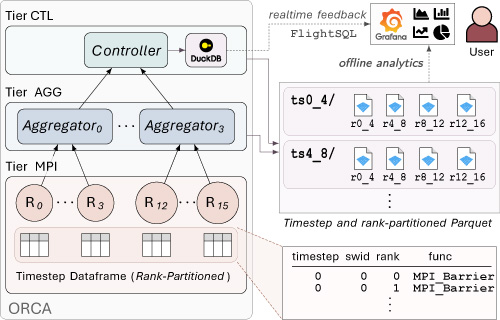
The bulk-synchronous parallel (BSP) paradigm powers critical computational workloads from scientific simulations to large-scale machine learning training. Running on tens of thousands of processors, these systems are uniquely sensitive to performance variations that current observability approaches struggle to diagnose—post-hoc analysis of massive traces introduces latency and rigidity that obstructs timely diagnosis. To address these challenges, we present ORCA, a system for always-on, steerable BSP observability. ORCA enables operators to materialize relevant views from running applications on demand and intervene in response, via a tree-based overlay providing coordinated collection, in-situ SQL analytics, and timestep-consistent control. ORCA accelerates observability workflows across the spectrum. On a real AMR code at 4096 ranks, ORCA collects equivalent traces at ∼2% overhead (vs 56–81% for tracing tools), enables up to 7275× faster queries, and 99.999% in-situ data reduction. In an LLM-driven evaluation of steerability, a performance anomaly that took us months to diagnose manually is localized in 27 minutes.
arXiv:2605.13749v3 [cs.PF] 18 Oct 2026.
We study the asymptotic response time tail in the M/G/𝑛 multi-server queue with heavy-tailed (regularly varying) job sizes, a setting representative of modern computing workloads. For single-server systems, tail optimization is well understood: under heavy-tailed job sizes, policies such as SRPT that strictly prioritize short jobs are strongly tail optimal, and giving any priority to large jobs is harmful. For multi-server systems, the question has been almost entirely open. This paper gives the first strongly tail-optimal scheduling policies for the M/G/𝑛 queue with heavy-tailed job sizes. Our central finding is that the multi-server case is intrinsically different from the single-server case: giving a small amount of “sympathy” to large jobs is essential for strong tail optimality. We establish strong (or arbitrarily close to strong) tail optimality across the full stability region, both with and without knowledge of job sizes.
arXiv:2605.04357v2 [cs.DC] 17 Oct 2026.
The landscape of large language models (LLMs) has become increasingly fragmented, with no single model dominating the field. Meanwhile, cloud providers offer a diverse array of mid-tier and older-generation GPUs. These heterogeneous resources provide better availability and deliver comparable performance-per-dollar to top-tier hardware. To efficiently harness these GPUs for concurrent multi-LLM serving, we introduce Coral: an adaptive, heterogeneity-aware serving system. The key idea behind Coral is the joint optimization of resource allocation and replica serving strategies across all models. To keep pace with shifting throughput demands and resource availability, Coral employs a lossless, two-stage decomposition. This approach preserves joint optimality while reducing online solve times from hours to mere tens of seconds. Evaluations across 6 models and 20 GPU configurations demonstrate that Coral reduces serving costs by up to 2.79× compared to the strongest baseline, while delivering up to 2.39× higher goodput under scarce resource constraints.
eBPF'26: Proceedings of the 4th Workshop on eBPF and Kernel Extensions, 29 September 2026- 2 October 2026, Prague, Czech Republic.
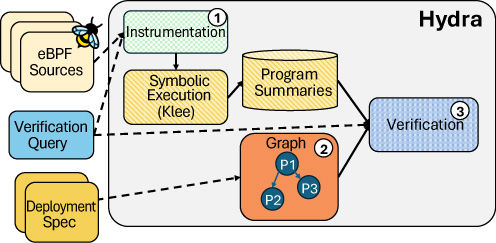
Production eBPF deployments now run as deep, dynamically composed chains of programs. Reasoning about the behavior of such chains is critical – e.g., an upstream program may silently overwrite a downstream’s routing decision. Existing symbolic-execution verifiers collapse under path explosion when confronted with large programs or the combinatorial space of deployed chains; their helper models, manually developed and incomplete, further erode soundness. We present Hydra, a verifier for eBPF deployments that(i) reframes verification at the granularity of program graphs,(ii) optimizes verification, with each program being efficiently transformed into path summaries that are reused across chains to answer graph-level queries; and (iii) creates accurate helper models, synthesized by LLMs and validated against the kernel via BPF_PROG_TEST_RUN + kcov. Across 12 programs and 27 synthetic program graphs, Hydra correctly verifies every chain with aggregate speedups over a monolithic baseline of at least ∼ 80× (up to 1,506×). Its helper models enumerate 2.5–6× more kernel-validated paths per helper than ebpf-se.
SOSP ’26, September 29th - October 2nd, 2026, Prague, Czech Republic.
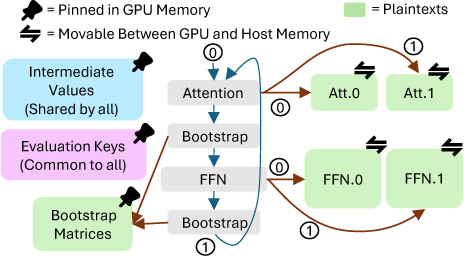
Encrypted AI using fully homomorphic encryption (FHE) enables inference directly over encrypted queries, providing strong privacy guarantees. However, its computational and memory overheads have limited practical deployment. Custom FHE accelerators improve performance, but rely on advanced manufacturing technologies that limit their accessibility. GPUs offer a more widely available alternative, yet achieving ASIC-class performance on GPUs is challenging. Large models such as LLMs compound these challenges by requiring optimized kernels, terabyte-scale memory management, and efficient execution across multiple devices. We present Cerium, a multi-GPU framework for largescale FHE inference. Cerium combines a domain-specific language, an optimizing compiler, and a runtime system to automatically generate optimized GPU kernels, compress plaintext data, manage terabyte-scale memory footprints, and optimize multi-GPU communication. Implemented onNVIDIA GPUs, Cerium outperforms expertwritten GPU libraries by up to 2.25× and achieves performance competitive with state-of-the-art FHE ASICs, matching the CraterLake ASIC. It is the first GPU system to execute CKKS bootstrapping in under 10 milliseconds, achieving 7.5 milliseconds, and is the first to demonstrate encrypted inference for BERT-Base and Llama3-8B prefill in 8 seconds and 43 seconds, respectively. The Cerium framework is open-source and available at https://github.com/CMU-CAOS/Cerium
arXiv:2609.14237v1 [cs.DC] 13 Sep 2026.
LLM serving systems increasingly disaggregate inference into finer-grained stages, with recent approaches separating attention from FFN or MoE execution during decode. This operator-level disaggregated serving (ODS) can improve hardware matching and enable independent scaling, particularly across heterogeneous devices. However, existing systems fix operator boundaries and lack a unified characterization of when disaggregation reduces serving cost. We present Op- Weave, an end-to-end framework for heterogeneous ODS. OpWeave provides an analytical cost model that bounds the gains of homogeneous and heterogeneous ODS over colocated serving. It jointly optimizes operator partitioning and deployment configuration through a regularity-aware planner that keeps the search tractable even for hybrid-attention models. A vLLM-based runtime executes the synthesized plans with flexible operator stages across heterogeneous device groups. In our evaluation, OpWeave reduces serving cost by up to 1.78× on homogeneous and 1.89× on heterogeneous GPU clusters relative to the best feasible baseline, while meeting latency SLOs.
Proceedings of the VLDB Endowment, Vol. 19, No. 4, ISSN 2150-8097, 2026. Presented at 52nd International Conference on Very Large Data Bases. Boston, MA, USA, Aug 31st - Sep 4th, 2026. BEST PAPER HONORABLE MENTION!
Cache eviction algorithms play a critical role in the performance of modern data systems, yet their scalability is often limited by the high computational overhead associated with object promotions. Lazy Promotion techniques have emerged as relaxations of traditional Least-Recently-Used (LRU) methods, designed to alleviate lock contention and increase throughput. This work uses production traces from real-world systems to benchmark five Lazy Promotion strategies: Probabilistic-LRU, Batch-LRU, Delay-LRU, FIFO-reinsertion, and Random-LRU. We evaluate these techniques across miss ratio, scalability, promotion count, and a novel metric called promotion efficiency, which measures the number of hits per promotion. Our results reveal that Delay-LRU and FIFO-reinsertion significantly improve promotion efficiency, whereas Batch-LRU and Probabilistic-LRU struggle to reduce promotions without significantly increasing miss ratio. We further explore the impact of lazy promotion in advanced algorithms such as ARC and 2Q and make a similar observation. Moreover, we uncover substantial optimization potential, showing that most cache promotions are unnecessary when equipped with oracle knowledge. To further reduce promotions in LRU, we propose two novel enhancements—Delayed FIFO-reinsertion (D-FR) and Age-Guided Eviction (AGE)—that reduce promotions by 20—60% while achieving a similar or lower miss ratio.
arXiv:2608.25185v1 [cs.DB] 25 Aug 2026.
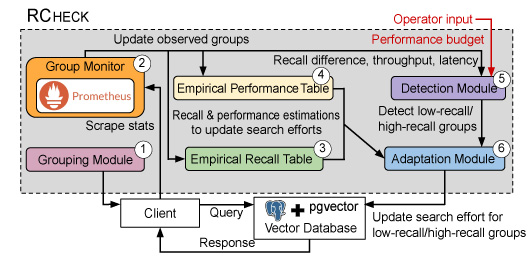
Modern database services scalably search over large data collections via Approximate Nearest Neighbor Search, which improves search performance at the cost of search quality, measured by recall. In practice, a database operator seeks to achieve a target mean recall while maximizing throughput across search queries. We show that optimizing for mean recall masks significant differences in recall across queries even when target recall is met. As a result, numerous queries face (1) below-target recall, hurting user experience and revenue and (2) above-target recall, wasting computation to deliver unnecessarily high search quality. Thus, it is critical to detect and reduce recall differences across queries. We design RCheck, a light-weight run-time system that identifies low-recall queries and reduces recall differences while achieving high throughput. RCheck’s key design principle is to dynamically, efficiently adapt search effort by increasing effort for queries below target recall and decreasing effort for those above it. RCheck tunes available search effort parameters, making it readily deployable. We evaluate RCheck using the widely-used production-style pgvector [6] database. At the same throughput, RCheck improves mean recall by 11–93% and enables 8–47% more queries to meet target recall compared to the state-of-the-art globally-tuned configuration.
SIGCOMM ’26, August 17 - 21, 2026, Denver, CO, USA.
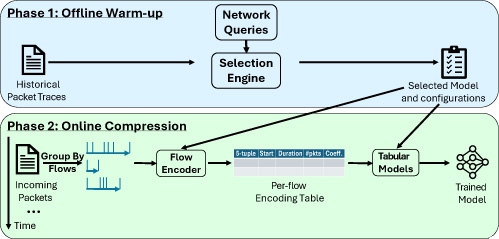
Long-term network packet traces (e.g., pcaps), if available, can enable and inform lots of management tasks. However, storing packet data at scale is very expensive, forcing operators to choose between coarse historical summaries or short retention windows. In this context, deep generative compression (DGC) offers a new hope to store compact model parameters and regenerate structurally accurate traces on demand. We evaluate the suitability of recent deep generative approaches [21, 24] for packet trace modeling and generation. We find that their fidelity metrics are disconnected from the domain-specific queries/use cases, and they have bad cost-fidelity trade-off. We propose DeePCAP, an end-to-end trace storage system to close this gap. DeePCAP introduces a query-driven fidelity framework spanning packet- and flow-level queries to tackle the fidelity disconnection, and proposes a novel dimensionality reduction approach using frequency domain encoding to improve cost-fidelity trade-off. Our preliminary results show that DeePCAP achieves the best fidelity on the 100+ query suite and the strongest cost–fidelity trade-off.
10th Asia-Pacific Workshop on Networking (APNet 2026), August 6–7, 2026, Singapore.
The performance of datacenter congestion control algorithms (CCAs) is highly sensitive to bursty traffic patterns, yet a significant fidelity gap exists between evaluation workloads and production traffic. Current evaluations primarily rely on synthetic workloads constructed from flow-size CDFs with incast overlaid on top, an approach that, while intuitive, we show produces traffic that is dissimilar to production in its temporal burst clustering. As a result, these workloads fail to exercise the full range of conditions that CCAs encounter in production, and hence, protocols that demonstrate gains in simulation risk diminished performance or unexpected failure modes upon deployment. This motivates the need for a deeper understanding of burstiness for CCA evaluation. To this end, we decompose burstiness into four key dimensions, and use DCTCP as a case study to show distinct behavioral regimes in each dimension. Building on this, we envision a burst-centric evaluation stack: behavioral regime analysis across various CCA classes, and a burst generator to ensure regime coverage along these dimensions, enabling thorough and robust evaluations.
arXiv:2602.01404v2 [cs.DC] 26 Jul 2026.
The past decade has seen a dramatic increase in demand for GPUs to train Machine Learning (ML) models. Because it is prohibitively expensive for most organizations to build and maintain a large GPU cluster, organizations instead rent GPUs from cloud providers. A cloud customer must decide (i) how many GPUs to rent at every moment in time to process a stream of training jobs and (ii) how to allocate the rented GPUs among the currently active jobs. While allocating more GPUs to a single training job helps the job complete more quickly, the customer pays for each GPU-hour they use. Because training jobs often receive a diminishing marginal benefit from running on additional GPUs, allocating too many GPUs to a single job can dramatically increase the cost the customer pays. This gives rise to a cost-performance tradeoff when training models in the cloud.
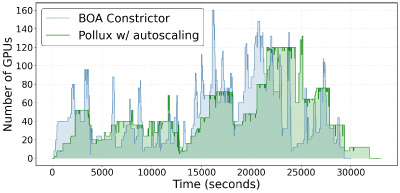
To balance the cost-performance tradeoff,we develop BOA Constrictor, a new scheduler for ML training jobs that uses a Budget-Optimal Allocation (BOA) policy to squeeze the most performance out of a cloud-based GPU cluster given a fixed budget. While prior approaches focus on fixed-sized clusters and heuristic approaches for balancing cost and performance, we formalize the problem as a budget-constrained scheduling problem. Given a monetary budget that the customer is willing to spend on GPUs, we derive the BOA policy that minimizes the average job completion time (JCT) of a stream of arriving jobs. Our BOA policy can be computed efficiently for any budget level, providing users with the optimal tradeoff between cost and performance. For a given budget level, BOA Constrictor can reduce average JCT by 1.6× in small-scale implementation experiments and by 2× in detailed, large-scale simulations compared to state-of-the-art schedulers. BOA Constrictor also reduces the budget needed to achieve a given average JCT by up to 2×.
20th USENIX Symposium on Operating Systems Design and Implementation (OSDI '26), July 13–15, 2026, Seattle, WA.
HDD capacities will greatly increase over the next ten years, lowering cost-per-TB in large-scale storage systems. Unfortunately, device bandwidth will not grow proportionally to device capacity. Hence, storage systems will face an IO wall where the demand for HDD IO will outstrip supply.
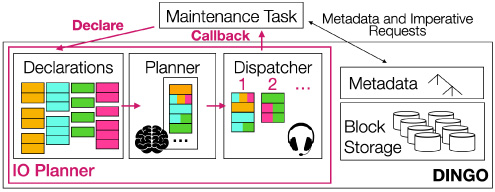
We find that, surprisingly, between 45% and 70% of after- cache HDD IO demand for 6 hyperscalers comes from crucial maintenance tasks that ensure data reliability and efficiency (e.g. scrubbing, garbage collection). Unfortunately, caching maintenance tasks is ineffective — individual tasks have little reuse and inter-task reuse is too far apart in time. Fortunately, maintenance tasks are flexible in the timing, ordering of data accesses, and even which data they access. However, the current imperative storage interface (e.g., read/write) hides maintenance tasks’ flexible nature. We propose Declarative IO, a new interface for distributed storage systems that allows developers to expose tasks’ flexibility to the storage system. This interface allows tasks to send a declaration to our dis- tributed storage system, DINGO, specifying sets of data and their associated deadlines, such as “process all blocks of this device within 7 days”. In processing declarations, DINGO coordinates IO across different tasks to create timely data reuse. DINGO achieves a 26–51% IO savings for maintenance task mixes corresponding to real hyperscalers, enabling the deployment of 1.7× larger HDDs than in imperative systems.
Proceedings of the 38th ACM Symposium on Parallelism in Algorithms and Architectures (SPAA '26). Royal Holloway, University of London, London, United Kingdom, July 6 - 10, 2026.
Processing-in-memory (PIM) is a promising architectural approach to mitigate the high cost of off-chip memory access by enabling (i) low-latency, on-memory-module data access and (ii) aggregate memory bandwidth that scales with the number of modules.
To fully exploit the potential of PIM systems, we formulate and study the PIM Scheduling problem, which captures the trade-offs between computation, data movement, and load balancing across a host CPU and multiple PIM modules. We establish fundamental lower bounds on the execution time of any schedule. We then design a non-preemptive clairvoyant algorithm that achieves a constant-factor approximation to the optimal schedule. More importantly, we develop a non-clairvoyant scheduling algorithm that does not know task work in advance, yet loses only a small additive term relative to the clairvoyant lower bound. Besides scheduling based on fixed data placement, we also prove a performance upper bound under uniform random data placement.
We evaluate our scheduling algorithms on both an analytical PIM simulator and a real-world 2048-module UPMEM-PIM machine. Both algorithms outperform baselines across various workload settings and hardware regimes, with up to 9.8× speedup in simulation and up to 1.8× speedup on real PIM hardware.
53rd Annual International Symposium on Computer Architecture (ISCA), June 27– July 1, 2026 Raleigh, USA.
GPU power consumption has become a central systems challenge as modern AI datacenters increasingly rely on accelerators whose power footprints reach unprecedented scales. A single NVIDIA B200 already draws around 1000W, making large multi-GPU nodes among the most power-hungry computing platforms ever deployed. Despite this, GPUs still expose only a single, device-wide DVFS domain. This coarse control is increasingly mismatched to modern AI inference, where power demand is highly non-uniform across models, phases, and workloads. LLMs alternate between compute-bound prefill and memory-bound decode phases, models exhibit widely varying kernel behavior, and emerging agentic pipelines chain together models with sharply different computational profiles. As GPUs shift toward multi-die designs and multi-model stacking becomes essential for utilization, a single global frequency increasingly leads to unnecessary and wasteful high-power operation.
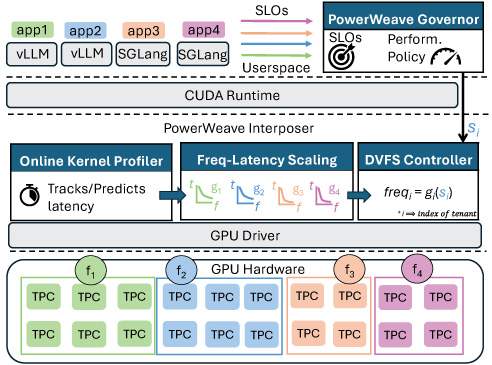
We introduce PowerWeave, the first spatial DVFS mechanism for GPUs, built around an OS-level power-management control plane. PowerWeave dynamically learns per-stream frequencyscaling behavior from kernel latencies and uses a global governor to react to request-rate changes, tail-latency behavior, and SLO slack. This design enables adaptive, fine-grained, kernel-aware power management that preserves SLOs while improving energy efficiency across diverse ML workloads.
We build PowerWeave in Rust as a fully transparent powergovernor layer atop the GPU driver and evaluate it across diverse LLM scenarios and agentic workloads on B200 GPUs. PowerWeave reduces energy consumption by 28% on average in both disaggregated-prefill and multitenant settings, achieving up to an 8× improvement over device-wide DVFS in disaggregated prefill. For agentic workflows, PowerWeave reduces energy consumption by 19% on average without compromising throughput. PowerWeave eliminates thermal throttling across all evaluated workloads while maintaining zero SLO violations. Finally, our hardware analysis shows that spatial DVFS is practical: even per- SM clock domains add less than 0.5% GPU die area overhead.
NSDI '26: 23rd USENIX Symposium on Networked Systems Design and Implementation Renton WA USA May 4 - 6, 2026.
Finetuning large language models (LLMs) is essential for task adaptation, yet today’s serving stacks isolate inference and finetuning on separate GPU clusters—wasting resources and under-utilizing hardware. We introduce FlexLLM, the first system to co-serve LLM inference and PEFT-based finetuning on shared GPUs by fusing computation at the token level. FlexLLM ’s static compilation optimizations—dependent parallelization and graph pruning significantly shrink activation memory, leading to end-to-end GPU memory savings by up to 80%. At runtime, a novel token-level finetuning mechanism paired with a hybrid token scheduler dynamically interleaves inference and training tokens within each co-serving iteration, meeting strict latency SLOs while maximizing utilization. In end-to-end benchmarks on LLaMA-3.1-8B, Qwen- 2.5-14B, and Qwen-2.5-32B, FlexLLM maintains inference SLO compliance at up to 20 req/s, and improves finetuning throughput by 1.9−4.8× under heavy inference workloads and 2.5−6.8× under light loads, preserving over 76% of peak finetuning progress even at peak demand. FlexLLM is publicly available at https://flexllm.github.io.
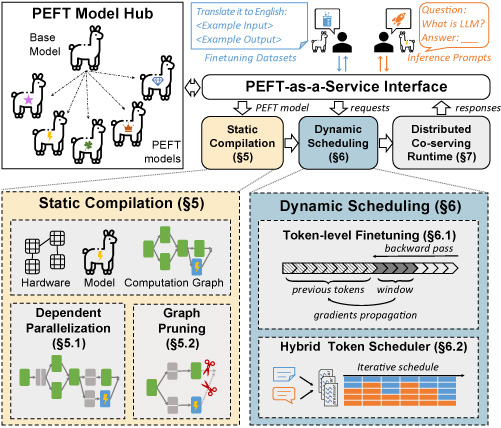
23rd USENIX Symposium on Networked Systems Design and Implementation. May 4–6, 2026, Renton, WA, USA.
All-to-All(v) communication is a critical primitive in modern machine learning workloads, particularly mixture-of-experts (MoE) models. Unfortunately, efficient scheduling is challenging due to workload skew, heterogeneous two-tier fabrics, and incast congestion, compounded by the dynamic nature of MoE workloads, where traffic shifts every few hundred milliseconds. Existing schedulers are hardly scalable, incurring seconds to hours of synthesis time, making them impractical.
We present FAST, an efficient All-to-All(v) scheduler. FAST addresses skew through intra-server rebalancing and enforces balanced, one-to-one scale-out transfers that avoid incast. Evaluated extensively on both NVIDIA H200 and AMD MI300X clusters, FAST consistently outperforms state-of-theart solutions on skewed workloads while reducing synthesis time by orders of magnitude.
EuroSys 2026, Edinburgh, Scotland, April 27th—30th, 2026.
Recent changes in data temperatures and storage device characteristics, both mechanical disk-drives (HDDs) and solid-state drives (SSDs), expand the set of deployment options for exascale storage. Until recently, exascale storage systems followed a pattern of placing most data on HDDs with smaller amounts of SSD storage used for caching and performance-critical workloads. Exascale storage provisioning and dataset placement trade-offs have now changed.
This paper describes a total cost of ownership (TCO) model that captures primary aspects of modern deployments and uses it to explore the new trade-off space. Using capacity and performance telemetry information for 43 production datasets+workloads at two large hyperscalers, we show significant changes from prior analyses of workloads and storage placement decisions across a multitude of storage device types. We also introduce a storage cluster TCO optimizer that identifies the lowest-TCO grouping and assignment of datasets to device types, exposing a number of insights that can help guide future deployments. For example, our analysis shows that the highest-density SSDs are particularly favor- able for clusters with heavy AI/ML workloads but are only cost-effective at exascale when combined with high-density HDDs. Finally, we use our framework to evaluate how storage provisioning and overall TCO change as a function of key parameters like device write amplification, cluster power bounds, and the maximum number of device types allowed.
EUROSYS ’26, Edinburgh, Scotland UK. April 27-30, 2026.
Modern large language model (LLM) applications exhibit diverse service-level objectives (SLOs), from low-latency requirements in interactive coding assistants to more relaxed constraints in data wrangling tasks. Existing LLM serving systems, which rely on uniform batching and scheduling strategies, often fail to meet these heterogeneous SLOs concurrently. We present AdaServe, the first LLM serving system designed to support efficient multi-SLO serving through SLO-customized speculative decoding. AdaServe formulates multi-SLO serving as a constrained optimization problem and introduces a hardware-aware algorithm that constructs a speculation tree tailored to each request’s latency target. It features a speculate-select-verify pipeline that enables fine-grained control over decoding speed while maximizing system throughput. AdaServe further adapts to workload variation by dynamically adjusting speculation parameters. Evaluations across diverse workloads show that AdaServe reduces SLO violations by up to 4.3× and improves goodput by up to 1.9× compared to the best-performing baselines, highlighting its effectiveness in multi-SLO serving.
Queueing Systems 110:28, April 2026.
Software caches are an intrinsic component of almost every computer system. Consequently, caching algorithms, particularly eviction policies, are the topic of many papers. Most of these prior papers evaluate the caching algorithm based on its hit ratio, namely the fraction of requests that are found in the cache, as opposed to disk. The “hit ratio” is viewed as a proxy for traditional performance metrics like system throughput or response time. Intuitively, it makes sense that a higher hit ratio should lead to higher throughput (and lower response time), since more requests are found in the cache (low access time) as opposed to the backend storage (high access time). This paper challenges this intuition.We show that increasing the hit ratio can actually hurt the throughput (and response time) for many caching algorithms. Specifically, higher hit ratios can lead to contention on the hit path, resulting in lower throughput. This is relevant in light of recent caching systems papers that have noticed that many LRU-based eviction policies can suffer from high contention and thus have aimed at developing solutions that reduce lock contention. Our paper provides a methodological framework to precisely determine where the contention is and how the hit ratio affects this. In particular, we are able to pinpoint the exact hit ratio beyond which throughput degrades, across a wide variety of eviction algorithms. Our investigation follows a three-pronged approach involving (i) queueing modeling and analysis, (ii) simulation to validate the accuracy of the queueing model, and (iii) implementation and measurement. We also show that the phenomenon of decreasing throughput at higher hit ratios is likely to be more pronounced in future systems, where the trend is toward faster disks and more cores per CPU.
SIGMOD Record, March 2026 (Vol. 55, No. 1).
Although user-defined functions (UDFs) are a popular way to augment SQL’s declarative approach with procedural code, the mismatch between programming paradigms creates a fundamental optimization challenge. UDF inlining automatically removes all UDF calls by replacing them with equivalent SQL subqueries. Although inlining leaves queries entirely in SQL (resulting in large performance gains), we observe that inlining the entire UDF often leads to suboptimal performance. A better approach is to analyze the UDF, deconstruct it into smaller pieces, and inline only the pieces that help query optimization. To achieve this, we propose UDF outlining, a technique to intentionally hide pieces of a UDF from the optimizer, resulting in simpler UDFs and significantly faster query plans. Our implementation (PRISM) demonstrates that UDF outlining improves performance over conventional inlining (on average 1.29⇥ speedup for DuckDB and 298.73⇥ for SQL Server) through a combination of more effective unnesting, improved data skipping, and by avoiding unnecessary joins.
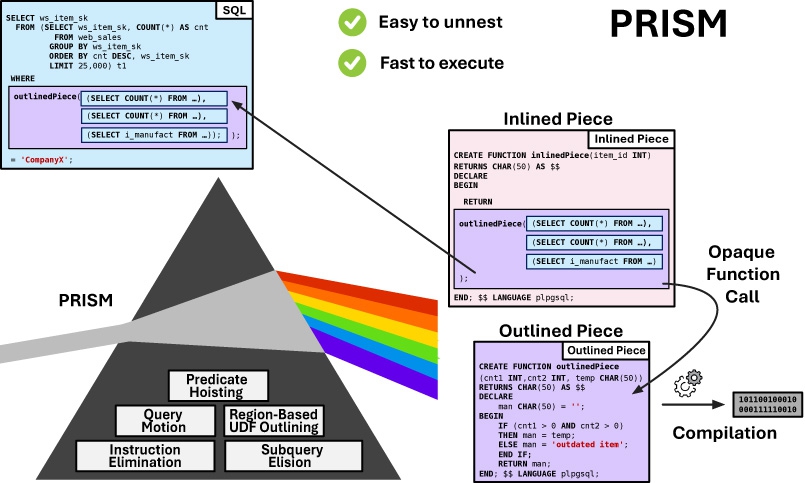
Proc. ACM Manag. Data, Vol. 4, No. 1 (SIGMOD), Article 90.
Publication date: February 2026 Tuning database management systems (DBMSs) is challenging due to trillions of possible configurations andevolving workloads. Recent advances in tuning have led to breakthroughs in optimizing over the possibleconfigurations. However, due to their design and inability to leverage query-level historical insights, existingautomated tuners struggle to adapt and re-optimize the DBMS when the environment changes (e.g., workloaddrift, schema transfer).This paper presents the Booster framework that assists existing tuners in adapting to environment changes(e.g., drift, cross-schema transfer). Booster structures historical artifacts into query-configuration contexts,prompts large language models (LLMs) to suggest configurations for each query based on relevant contexts,and then composes the query-level suggestions into a holistic configuration with beam search. With multipleOLAP workloads, we evaluate Booster’s ability to assist different state-of-the-art tuners (e.g., cost-/machinelearning-/LLM-based) in adapting to environment changes. By composing recommendations derived fromquery-level insights, Booster assists tuners in discovering configurations that are up to 74% better and in upto 4.7× less time than the alternative approach of continuing to tune from historical configurations.
ASPLOS '26: 31st ACM International Conference on Architectural Support for Programming Languages and Operating Systems Pittsburgh PA USA March 22 - 26, 2026.
Silent Data Corruption (SDC) poses a reliability threat inmodern datacenters. These insidious errors evade detectionsand propagate incorrect results throughout the system. Companies including Google, Meta, and Alibaba have reported SDC incidents affecting their production. In this paper, we present the first comprehensive instruction- and application-level analysis of vector instruction SDCs in hyper-scale datacenters using a two-stage approach. We perform over 78 trillion test rounds in more than 14 billion CPU seconds.Our observations reveal undocumented SDC patterns that provide insights into possible underlying causes and inspire new mitigation strategies. Based on these findings, we propose a low-overhead SDC detection mechanism leveraging in-application algorithm-based fault tolerance. Our method achieves 88% to 100% SDC machine detection rate with a time overhead of only 1.35% even for modestly sized inputs.
arXiv:2602.08800v1 [cs.OS] 9 Feb 2026.
Memory is becoming an ever-larger portion of system cost and power in datacenters. Memory expansion via Compute Express Link (CXL) provides an effective way to provide additional memory at lower cost and power. However, making effective use of CXL memory requires software-level memory tiering support for most hyperscaler workloads. Many tiering solutions have been proposed. However, our observations from deploying CXL-enabled servers across a wide range of workloads at a hyperscaler reveal fundamental limitations in both prior approaches and the current Linux support. First, existing mechanisms lack multi-tenancy support, failing to robustly handle either stacked homogeneous or heterogeneous workloads. Second, their control planes offer limited flexibility in balancing memory across tiers, leading to fairness violations and uncontrolled performance variability. Finally, current systems provide insufficient observability, depriving operators of the visibility needed to diagnose performance pathologies at scale. In this paper, we present Equilibria, the first operating system framework that directly tackles these challenges and enables fair, multi-tenant CXL memory tiering at datacenter scale. Equilibria provides per-container controls for memory fairshare allocation and fine-grained observability of tiered-memory usage and operations. It further enforces flexible, user-specified fairness policies through regulated promotion and demotion, and mitigates noisy-neighbor interference by suppressing thrashing. We evaluate Equilibria in the fleet of a large hyperscaler using both production workloads and industry-standard benchmarks. Our results show that Equilibria consistently helps workloads meet their service level objectives (SLOs) while avoiding performance interference. Overall, Equilibria improves performance over the state-of-the-art Linux solution, TPP, by up to 52% and 1.7× for production workloads and benchmarks, respectively. All Equilibria patches have been released to the Linux community.
PPoPP '26: Proceedings of the 31st ACM SIGPLAN Annual Symposium on Principles and Practice of Parallel Programming. 31 January - 4 February, 2026 Sydney, Australia.
Space-partitioning indexes are widely used for managing multi-dimensional data, but their throughput is often memorybottlenecked. Processing-in-memory (PIM), an emerging architectural paradigm, mitigates memory bottlenecks by embedding processing cores directly within memory modules, allowing computation to be offloaded to these PIM cores.
In this paper, we present PIM-zd-tree, the first spacepartitioning index specifically designed for real-world PIM systems. PIM-zd-tree employs a tunable multi-layer structure, with each layer adopting distinct data layouts, partitioning schemes, and caching strategies. Its design is theoretically grounded to achieve load balance, minimal memory-channel communication, and low space overhead. To bridge theory and practice, we incorporate implementation techniques such as practical chunking and lazy counters. Evaluation on a real-world PIM system shows that PIM-zd-tree’s throughput is up to 4.25× and 99× higher than two state-of-the-art shared-memory baselines.
Proceedings of the VLDB Endowment, Vol. 19, No. 4, ISSN 2150-8097, 2026.
Cache eviction algorithms play a critical role in the performance of modern data systems, yet their scalability is often limited by the high computational overhead associated with object promotions. Lazy Promotion techniques have emerged as relaxations of traditional Least-Recently-Used (LRU) methods, designed to alleviate lock contention and increase throughput. This work uses production traces from real-world systems to benchmark five Lazy Promotion strategies: Probabilistic-LRU, Batch-LRU, Delay-LRU, FIFO-reinsertion, and Random-LRU. We evaluate these techniques across miss ratio, scalability, promotion count, and a novel metric called promotion efficiency, which measures the number of hits per promotion. Our results reveal that Delay-LRU and FIFO-reinsertion significantly improve promotion efficiency, whereas Batch-LRU and Probabilistic-LRU struggle to reduce promotions without significantly increasing miss ratio. We further explore the impact of lazy promotion in advanced algorithms such as ARC and 2Q and make a similar observation. Moreover, we uncover substantial optimization potential, showing that most cache promotions are unnecessary when equipped with oracle knowledge. To further reduce promotions in LRU, we propose two novel enhancements—Delayed FIFO-reinsertion (D-FR) and Age-Guided Eviction (AGE)—that reduce promotions by 20—60% while achieving a similar or lower miss ratio.
MICRO 2025 58th IEEE/ACM International Symposium on Microarchitecture, October 18-22, 2025. Seoul, Korea.
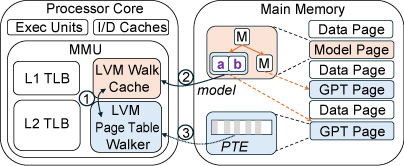
The rise in memory demands of emerging datacenter applications has placed virtual memory translation in the spotlight, exposing it as a significant performance bottleneck. To address this problem, this paper introduces Learned Virtual Memory (LVM), a page table structure that effectively provides optimal single-access address translation. LVM is founded on a novel learned index model that dynamically adapts the address translation procedure based on the characteristics of an application’s virtual address space. Furthermore, LVM’s learned index requires minimal memory space, does not impose stringent physical contiguity requirements, enjoys high cacheability in the MMU, efficiently supports insertions, and relies on simple fixed-point arithmetic. Finally, LVM supports all features of virtual memory, including multiple page sizes. We evaluate LVM with a set of operating system (OS) extensions in Linux, RTL synthesis, and full-system simulations across a wide range of workloads. LVM reduces the address translation overhead by an average of 44% over radix page tables, while reducing the page walk cache area required by 1.5×. Overall, LVM achieves a 2-27% speedup in application execution time and is within 1% of an ideal page table.

PDL photos from Retreat - March 2026